
Let’s start this course by talking honestly about something most English learners feel — but rarely say out loud.
You’ve studied English for years. You’ve passed exams. You know grammar rules. You’ve memorized vocabulary. And yet, when you’re asked a simple question in real life, when you have to explain an idea, join a discussion, or respond quickly in English, your confidence drops. You hesitate. You translate in your head. Sometimes, your mind goes completely blank.
This lesson explains why that happens — and more importantly, why it’s not your fault.
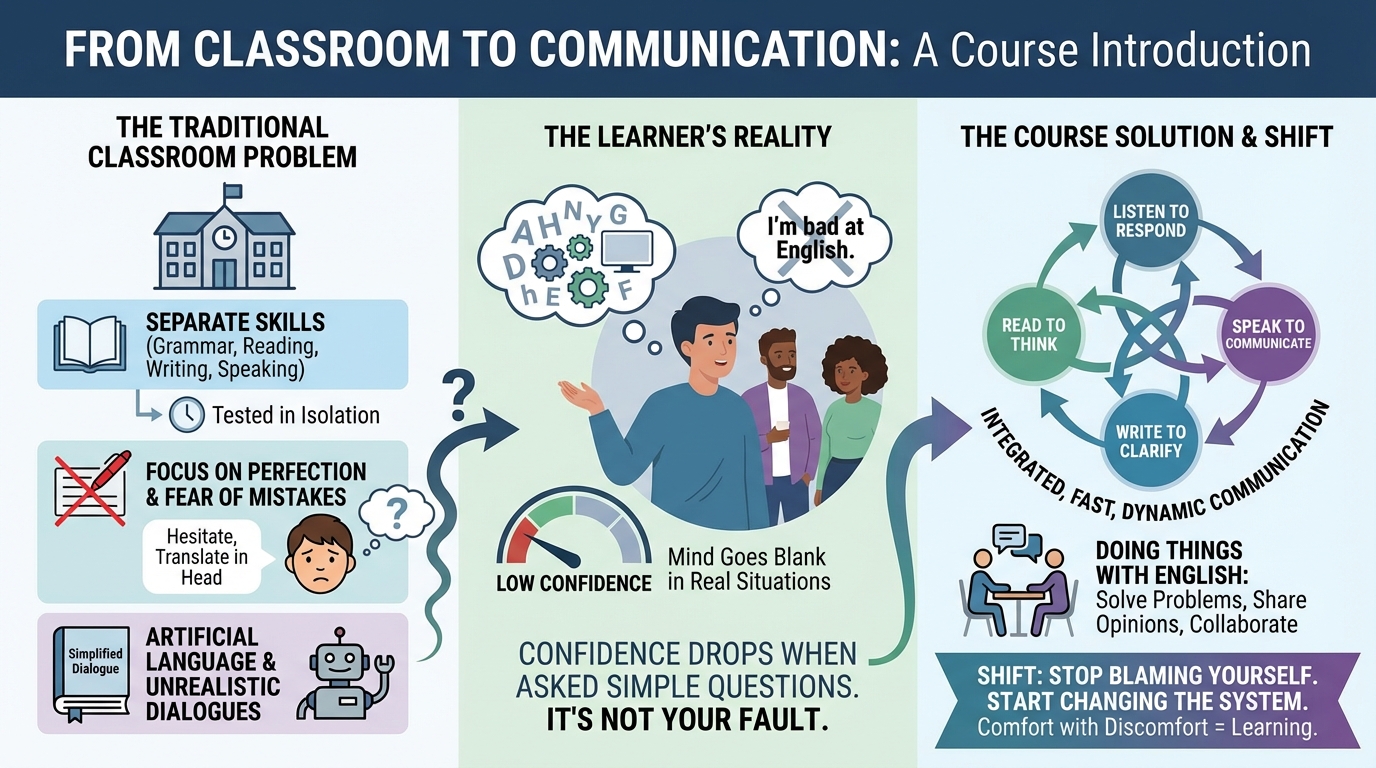
Traditional classroom English was never designed for real communication. It was designed for testing. In most classrooms, English is broken into separate pieces. One lesson for grammar. One lesson for reading. One lesson for writing. Maybe one short speaking activity at the end, if there’s time. Each skill is treated like it exists on its own.
But real life doesn’t work that way.
When you have a real conversation, you don’t “activate” listening first and speaking later. You listen, process meaning, think critically, respond, adjust your language, and read the other person’s reaction — all at the same time. Communication is integrated, fast, and dynamic.
The problem is that classroom English trains your brain to separate these skills. Exams often test them in isolation too. You may have a reading paper, a writing paper, a listening paper, and a speaking test — all separate. So your brain learns English as four different activities instead of one communication system.
That’s why many learners sound confident on paper but feel lost in conversation.
Another issue is the focus on perfection. In many classrooms, mistakes are treated as something to avoid. Students are corrected immediately. Errors are highlighted in red. Over time, learners start believing that they should only speak when they are “correct.” This creates fear — fear of embarrassment, fear of sounding foolish, fear of being judged.
In real communication, perfection doesn’t exist.
Native speakers interrupt themselves. They change sentences halfway through. They search for words. They make grammar mistakes — and communication still works. But classroom English often hides this reality, giving learners a false idea of what “good English” looks like.
There’s also the problem of artificial language. Many textbooks use simplified dialogues that don’t reflect how people actually speak. Conversations are too slow, too polite, too neat. Then, when learners hear real English — different accents, faster speech, informal expressions — it feels overwhelming.
So when learners struggle in real situations, they often think, “I’m bad at English.”
The truth is different.
You were trained for a system that does not match real communication.
This course exists to correct that mismatch.
From this point forward, you’ll stop learning English as separate skills. Instead, you’ll train your brain to use English the way life uses it. You’ll listen in order to respond. You’ll read in order to think. You’ll speak in order to communicate ideas, not impress with grammar. You’ll write in order to clarify your thinking, not just to be corrected.
This does not mean grammar and accuracy don’t matter. They do. But they are tools — not the goal.
Throughout this course, you’ll notice something important: you will be asked to do things with English. Solve problems. Share opinions. Reflect. Collaborate. Even when tasks feel challenging, that discomfort is a sign that your brain is learning to integrate skills — and that’s exactly what real communication requires.
By the end of this lesson, the most important shift is this:
Stop blaming yourself. Start changing the system you use to learn English.
In the next lesson, you’ll learn how English actually works in the real world — and what integrated communication really looks like in action.
Before you move on, complete the short quiz, assignment, and worksheet for this lesson. These are not about getting perfect answers. They’re about helping you reflect, notice patterns, and begin thinking differently about English.
When you’re ready, continue to Lesson 2.

