You asked why this project is necessary when others exist. Here is your justification for the industry:
The Contextual Gap
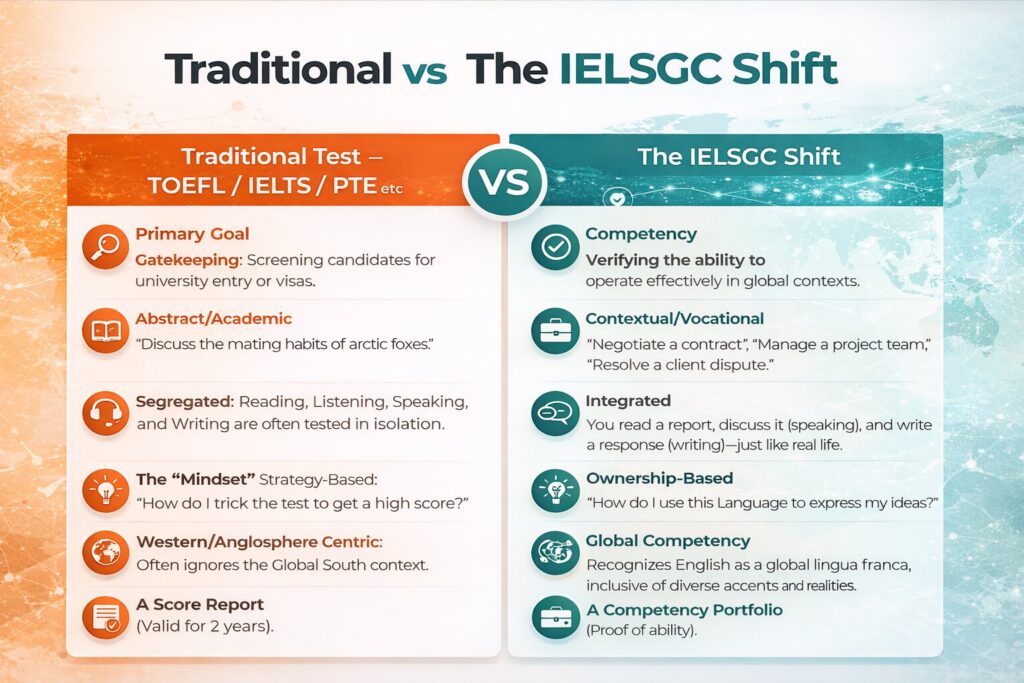
Current tests measure English in a vacuum. A student might score 7.5 on IELTS for instance but freeze when a client yells at them in English or when they need to explain a complex technical issue in a workshop. IELSGC fills this gap by testing Contextual Intelligence—knowing what to say, how to say it, and when to say it in real professional scenarios.
The Vocational Necessity
As a MINEFOP-accredited center, WESCO knows that vocational skills (welding, IT, management etc) require a different kind of English. IELSGC validates that a professional can perform their trade in English. TOEFL does not tell an employer if a nurse can comfort a patient in English; IELSGC does.
Decolonizing the Standard
Many global tests penalize non-native accents or cultural distinctiveness even if the communication is clear. IELSGC, backed by TESOL Africa, promotes International Intelligibility over “Native Speaker Mimicry.” It validates that you don’t need to sound British to be globally competent; you need to be clear, confident, and effective.
The IELSGC is not an exam; it is a proof of professional reality. Unlike traditional standardized tests that measure how well you study for an exam, the IELSGC measures how well you have integrated English into your mindset, your career, and your daily interactions. It is the bridge between ‘learning English’ and ‘living in English’.
Don't Just Learn English. Own It.
Do you like to put your texts on solid color? Leverage the rounded color style accordion
These tests treat English like a "rental car." The learner rents the language for 3 hours to pass an exam, follows strict rules, and often forgets it afterward. It is performative.
This framework treats English as a tool you own. It focuses on "Language Ownership"—the ability to internalize the language so it becomes a natural extension of the learner's professional and social identity.
While TOEFL and IELTS fight for the Academic/Immigration "Gatekeeper" position, IELSGC should claim the Vocational & Professional Competency position.
Target Audience: Professionals, vocational trainees, entrepreneurs, and global workers who need to do things in English, not just write essays about abstract topics.
The Pitch: "Don't just prove you can take a test. Prove you can handle the world."
The Core Philosophy: Language Ownership vs. Language Rental
the 5 Pillars of IELSGC Assessment
Pillar 1: Integrated Processing (The “I” in IELSGC) The Shift: Traditional tests isolate skills (Speaking Section, Writing Section). Real life does not. The IELSGC Standard: You never use one skill in isolation. ssessment Concept: “Input-to-Output Looping.” The candidate must read an email (Input), discuss the problem with an examiner (Interaction), and then write a solution (Output). Why it matters: This proves the learner can synthesize information, not just memorize answers.
Pillar 2: Contextual Intelligence The Shift: Traditional tests use generic, abstract topics (e.g., “Space exploration”). The IELSGC Standard: Language changes based on who you are talking to and where you are. Assessment Concept: “Register Shifting.” The candidate is tested on their ability to switch tones. Can they speak formally to a superior and then informally to a colleague about the same topic? Why it matters: This creates the “shift of mindset” you mentioned—teaching learners that English is a tool for social navigation, not just a set of rules.
Pillar 3: Vocational Operationality (The WESCO Anchor) The Shift: Traditional tests are academic. They don’t predict job performance. The IELSGC Standard: English as a trade tool. Assessment Concept: “Task Completion.” The grade is not just based on grammar accuracy, but on success. Did they successfully negotiate the price? Did they successfully calm the angry customer? Why it matters: This aligns perfectly with MINEFOP accreditation. It treats English as a vocational skill (like computing or accounting) rather than a subject.
Pillar 4: Strategic Interaction (Soft Skills) The Shift: In TOEFL/IELTS, you speak at a computer or an examiner. It is a monologue. The IELSGC Standard: Communication is a two-way street. Assessment Concept: “Repair and Clarification.” We test the learner’s ability to handle difficulties. If they don’t understand, do they ask for clarification politely? If they make a mistake, do they self-correct? Why it matters: This is the “Ownership” aspect. An owner of the language feels confident enough to say, “Could you please rephrase that?” A “renter” just panics.
Pillar 5: Global Intelligibility (The TESOL Africa Stance) The Shift: Traditional tests often penalize accents that deviate from “Standard American” or “Received Pronunciation” (British). The IELSGC Standard: Clarity over mimicry. Assessment Concept: “International Comprehensibility.” The focus is on pronunciation features that affect understanding (stress, intonation, grouping) rather than native accent imitation. Why it matters: This decolonizes the test. It empowers the African learner to keep their identity while being globally competent.
How this looks in practice - The Exam vs. The Experience
Traditional Test Task
IELSGC Task (The Shift)
Write an Essay: “Do you agree that technology connects people?” (300 words)
Project Simulation: “You have received a complaint from a client about a technical delay. Read the complaint, leave a voice note for your manager explaining the situation, and write a polite reply to the client.”
Speaking: Describe your hometown.
Roleplay: You are guiding a foreign visitor through your city (Douala). Advise them on safety, transport, and food based on their specific questions.
“Our experience isn’t just about years in the classroom; it’s about relevance in the real world. We pride ourselves on 90% Assessment Accuracy, ensuring that every grade reflects true ability. With a curriculum designed for Real-World Relevance, we don’t just teach you to pass a test—we prepare you to communicate globally.”
Statistic & Analytic
0%
Audit Preparation
0%
Management Consulting
0%
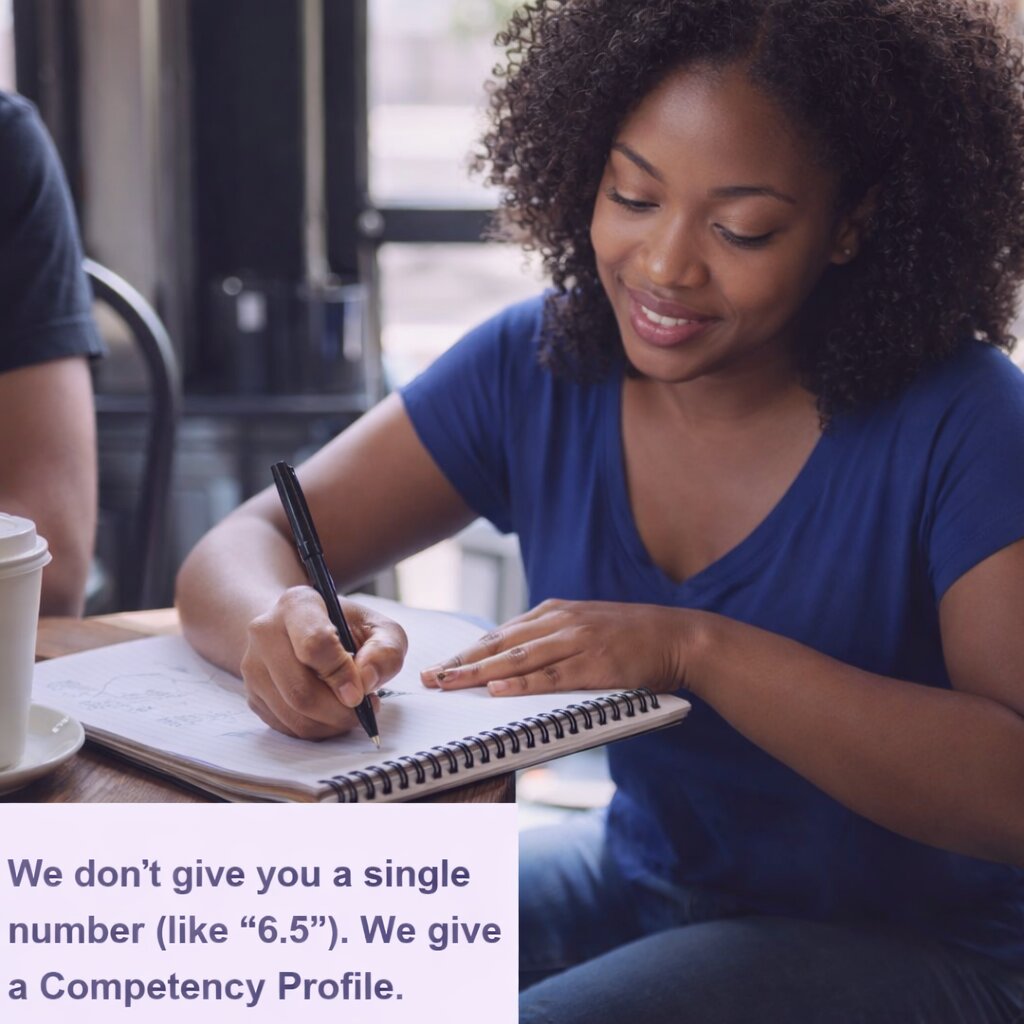
We Don't Count Mistakes. We Measure Impact.
Why This Works
If you didn’t listen to the voicemail, you wouldn’t know to offer the discount in your email. This proves you are competent at integrating information, not just literate in isolated skills.